

Could aromatherapy for Alzheimer’s actually help? Your mom hasn’t slept through the night in weeks. She’s agitated and anxious, and nothing seems to calm her.
The medications cause side effects that make everything worse. You’re desperate for something — anything — that might help without adding another pill to her already overwhelming regimen.
What if the answer was as simple as lavender?
It sounds too good to be true. And honestly, aromatherapy won’t cure Alzheimer’s or reverse cognitive decline. But a growing body of research — including a 2024 meta-analysis of 15 randomized controlled trials — suggests that certain essential oils may offer something pharmaceutical treatments often can’t: relief from agitation, anxiety, and sleep disturbances without harmful side effects.
More than 7.2 million Americans age 65 and older are living with Alzheimer’s disease — and nearly all of them experience behavioral and psychological symptoms that are sometimes harder to manage than the memory loss itself: anxiety, agitation, aggression, sleep disturbances, and sundowning. In fact, research shows that up to 90% of dementia patients experience these behavioral and psychological symptoms at some point during their illness.
Could aromatherapy help? The research is limited but surprisingly promising.
This article examines what science actually shows about essential oils and Alzheimer’s — what works, what doesn’t, and how to use aromatherapy safely as part of a comprehensive care plan.
What Is Aromatherapy?
Aromatherapy is the therapeutic use of essential oils — concentrated plant extracts that contain aromatic compounds.
How it works:
When you inhale essential oils, aromatic molecules enter the nose and stimulate the olfactory system — the part of the brain connected to smell. The olfactory bulb has direct connections to:
- The limbic system — Controls emotions, behavior, and memory
- The amygdala — Processes emotional responses (fear, anxiety, pleasure)
- The hippocampus — Involved in memory formation
This is why smell is so powerfully connected to memory and emotion. A familiar scent can instantly transport you back decades — triggering vivid memories and strong feelings.
In Alzheimer’s patients, this connection can be used therapeutically to calm anxiety, improve sleep, and enhance alertness.
The Challenge: Alzheimer’s Often Damages the Sense of Smell
Here’s the complication: Alzheimer’s disease often impairs the sense of smell, sometimes very early in the course of the disease. In fact, olfactory dysfunction is now recognized as one of the earliest clinical manifestations of the disease — often appearing before noticeable cognitive symptoms.
Studies show that while only about 6% of Alzheimer’s patients complain of smell decline, approximately 90% demonstrate significant impairment when formally tested. Odor identification — the ability to recognize and name specific scents — is particularly affected.
Does this mean aromatherapy won’t work?
Not necessarily. Research suggests aromatherapy may still provide benefits through:
- Residual smell capacity — Even partial smell function may be enough for a therapeutic effect
- Topical absorption — Some essential oils can be absorbed through the skin
- Psychological and environmental effects — The ritual of aromatherapy, a calm environment, and caregiver attention may provide indirect benefits
What Does Research Show About Aromatherapy for Alzheimer’s?
Aromatherapy research in Alzheimer’s has grown substantially in recent years. A 2024 meta-analysis published in the Journal of the American Medical Directors Association analyzed 15 randomized controlled trials involving 821 patients — providing the most comprehensive evidence to date.
The 2024 Meta-Analysis: Strong Evidence for Reducing Agitation
Published in: Journal of the American Medical Directors Association (2024)
What they analyzed: 15 randomized controlled trials comparing aromatherapy with control treatments in dementia patients
Key findings:
- Significant reduction in behavioral and psychological symptoms after one month of aromatherapy treatment
- Meaningful improvement in agitation scores as measured by the Cohen-Mansfield Agitation Inventory
- Improved neuropsychiatric symptoms across multiple measures
- Aromatherapy combined with massage showed even higher efficacy
- No significant adverse effects reported
Why it matters: This meta-analysis provides the strongest evidence yet that aromatherapy is a safe, viable non-pharmacological treatment for behavioral and psychological symptoms in dementia.
The 2025 Integrative Review: Understanding How to Use Aromatherapy
Published in: Journal of Integrative Nursing (2025)
What they analyzed: 28 studies examining aromatherapy interventions across the cognitive impairment spectrum
Key findings:
- Inhalation is the most prevalent and effective delivery method
- Massage and combined approaches also show benefits
- Lavender remains the most commonly studied essential oil for dementia-related symptoms
Earlier Studies That Built the Foundation
Rosemary and Lemon in the Morning, Lavender and Orange at Night (Psychogeriatrics, Japan):
This structured aromatherapy program used stimulating oils (rosemary and lemon) in the morning and calming oils (lavender and orange) in the evening. Results showed improved cognitive function on standardized tests, better sleep patterns, and reduced behavioral disturbances.
Why it may work: Rosemary contains compounds that may increase acetylcholine, a neurotransmitter critical for memory. Citrus oils have mood-lifting properties, while lavender interacts with GABA receptors in the brain (the same receptors targeted by anti-anxiety medications, but without the side effects).
Lemon Balm Reduces Agitation (Journal of Clinical Psychiatry):
When lemon balm essential oil was applied topically (mixed with a carrier oil and massaged into the arms) in Alzheimer’s patients, 60% showed reduced agitation, along with improved quality-of-life scores and calmer interactions with caregivers.
The Most Promising Essential Oils for Alzheimer’s
Based on current research, these essential oils show the most potential for managing Alzheimer’s symptoms:
1. Lavender (Lavandula angustifolia)
Best for:
- Reducing agitation and anxiety
- Improving sleep quality
- Calming sundowning behavior
- General relaxation
How to use:
- Diffuse in the bedroom 30 minutes before bedtime
- Apply diluted oil to a pillowcase
- Use in massage (diluted with carrier oil)
- Add to warm bath water
Safety: Generally very safe. Avoid ingestion.
2. Lemon Balm (Melissa officinalis)
Best for:
- Reducing irritability and restlessness
- Mild sedation without grogginess
- Calming aggressive behavior
How to use:
- Apply topically (diluted in carrier oil like coconut or almond oil)
- Gentle hand or arm massage
- Diffuse during agitated periods
Safety: Very safe. May interact with thyroid medications (consult doctor).
3. Rosemary (Rosmarinus officinalis)
Best for:
- Enhancing alertness and cognitive function
- Reducing mental fatigue
- Morning stimulation
How to use:
- Diffuse in the morning or early afternoon
- Avoid evening use (may interfere with sleep)
Safety: Safe in aromatherapy. Avoid in people with epilepsy or high blood pressure.
4. Lemon (Citrus limon)
Best for:
- Improving alertness and concentration
- Elevating mood
- Reducing confusion
How to use:
- Diffuse during daytime activities
- Combine with rosemary for cognitive stimulation
Safety: Very safe. Avoid direct skin application before sun exposure (citrus oils are photosensitive).
5. Orange (Citrus sinensis)
Best for:
- Reducing anxiety
- Improving mood
- Evening relaxation (less sedating than lavender)
How to use:
- Diffuse in the evening
- Combine with lavender for a bedtime routine
Safety: Very safe. Same photosensitivity caution as lemon.
6. Peppermint (Mentha piperita)
Best for:
- Increasing alertness
- Reducing mental fatigue
- Nausea relief
How to use:
- Diffuse during morning hours
- Avoid evening use
Safety: Safe in small amounts. Too much can be overstimulating.
How to Use Aromatherapy Safely with Alzheimer’s Patients
1. Choose High-Quality Essential Oils
Not all essential oils are created equal.
✓ Look for:
- 100% pure essential oils (not “fragrance oils” or synthetic)
- Therapeutic grade
- Latin name on the label (e.g., Lavandula angustifolia)
- Dark glass bottles (essential oils degrade in light)
✕ Avoid:
- Oils with added ingredients
- Suspiciously cheap oils (quality oils are expensive)
- Oils without proper labeling
2. Use a Diffuser (Safest Method)
The 2025 integrative review confirmed that inhalation is the most prevalent and effective delivery method for aromatherapy in dementia care.
Why diffusers are ideal:
- No direct skin contact (reduces allergy risk)
- Controlled exposure
- Easy to discontinue if the patient reacts poorly
- Creates a calming environment
Types of diffusers:
- Ultrasonic diffusers (best option) — Use water and ultrasonic vibrations to disperse oil into a mist
- Nebulizing diffusers — Uses only pure essential oil (more substantial effect, more expensive)
- Heat diffusers — NOT recommended (heat can alter chemical composition)
How to use:
- Add 3-5 drops of essential oil to the diffuser
- Run for 30-60 minutes
- Turn off for 1-2 hours, then repeat if needed
- Don’t run continuously (nose becomes desensitized)
3. Dilute Oils for Topical Application
Never apply undiluted essential oils directly to skin — they can cause irritation, burns, or allergic reactions.
Proper dilution:
- For elderly skin: 1% dilution (1 drop essential oil per teaspoon of carrier oil)
- For massage: Mix essential oil with carrier oil (coconut, almond, jojoba)
How to apply:
- Gentle hand or foot massage
- Apply to wrists, temples, or the back of the neck
- Add diluted oil to the lotion
Do a patch test first: Apply a small amount to the inner arm and wait 24 hours to check for a reaction.
4. Create a Routine
Consistency amplifies benefits.
Sample aromatherapy routine for Alzheimer’s:
Morning (7-9 AM):
- Diffuse rosemary and lemon oils
- Open windows for natural light
- Helps stimulate alertness for the day
Afternoon (2-4 PM):
- Brief aromatherapy break with orange or peppermint
- Pair with a light snack
- Helps combat afternoon fatigue
Evening (6-8 PM):
- Diffuse lavender and orange oils
- Dim lights, reduce noise
- Signals bedtime approaching
Bedtime (30 minutes before sleep):
- Lavender on a pillowcase or diffused in the bedroom
- Gentle hand massage with diluted lavender oil
- Creates a calming sleep environment
5. Monitor for Adverse Reactions
While essential oils are generally safe, watch for:
✕ Allergic reactions:
- Skin rash, redness, or itching
- Difficulty breathing
- Watery eyes or a runny nose
✕ Overstimulation:
- Increased agitation (some oils energize rather than calm)
- Headache
- Nausea
If any reaction occurs: Stop use immediately and ventilate the room.
6. Avoid These Common Mistakes
✕ Don’t ingest essential oils — Some are toxic when swallowed
✕ Don’t use undiluted oils on skin — Causes irritation
✕ Don’t diffuse continuously all day — Nose becomes desensitized, effectiveness decreases
✕ Don’t use stimulating oils at night — Rosemary, peppermint, lemon interfere with sleep
✕ Don’t use essential oils near eyes or mucous membranes — Causes burning
✕ Don’t assume “natural” means “harmless” — Essential oils are potent compounds
What Aromatherapy Can and Cannot Do
What Aromatherapy MAY Help:
- Reduce agitation and restlessness
- Improve sleep quality
- Decrease anxiety
- Enhance mood
- Provide mild cognitive stimulation
- Reduce the need for sedative medications
- Create a calming environment
- Offer a sense of comfort and routine
What Aromatherapy CANNOT Do:
- Cure Alzheimer’s disease
- Reverse cognitive decline
- Stop disease progression
- Replace medications
- Restore lost memories
- Prevent Alzheimer’s
Aromatherapy is a complementary therapy — it works alongside medical treatment, not instead of it.
Combining Aromatherapy with Other Holistic Approaches
Aromatherapy works best as part of a comprehensive, holistic care plan:
✓ Music therapy — Familiar songs trigger positive memories and emotions
✓ Light therapy — Bright light in the morning regulates circadian rhythms
✓ Massage and touch — Reduces anxiety, provides comfort
✓ Nature exposure — Outdoor time improves mood and reduces agitation
✓ Structured routines — Predictability reduces confusion and stress
✓ Meaningful activities — Engagement supports cognitive function
✓ Proper nutrition — Brain health depends on adequate nutrients
✓ Social interaction — Reduces isolation and depression
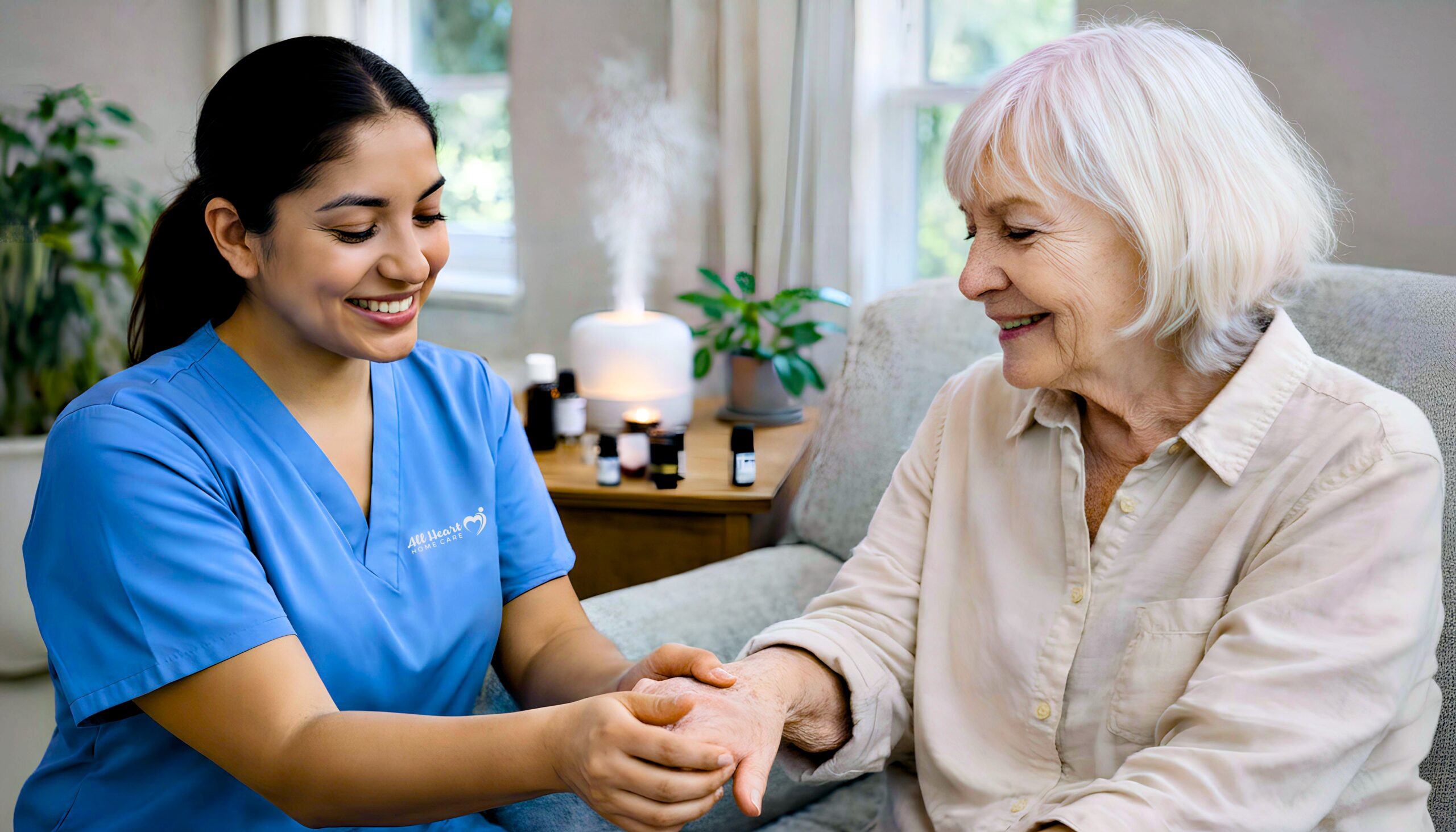
How All Heart Home Care Integrates Aromatherapy into Alzheimer’s Care
At All Heart Home Care, we train our caregivers in evidence-based, holistic approaches to Alzheimer’s care — including aromatherapy for Alzheimer’s patients as part of our comprehensive care plans.
How Our Caregivers Use Aromatherapy:
✓ Creating personalized aromatherapy routines — Morning stimulation with rosemary/lemon, evening relaxation with lavender/orange
✓ Safe diffuser operation — Proper dilution, timing, and oil selection
✓ Aromatherapy massage — Gentle hand and foot massage with diluted calming oils
✓ Monitoring responses — Tracking which oils help or cause overstimulation
✓ Coordinating with families — Communicating what works and adjusting as needed
✓ Integrating with other holistic approaches — Music, outdoor time, meaningful activities, structured routines
Beyond Aromatherapy, Our Alzheimer’s Caregivers Provide:
✓ Compassionate companionship — Reducing loneliness and anxiety
✓ Cognitive stimulation activities — Puzzles, reminiscence, music, art
✓ Assistance with daily living — Bathing, dressing, eating, mobility
✓ Medication reminders — Ensuring treatment compliance
✓ Meal preparation — Brain-healthy nutrition
✓ Safety supervision — Preventing wandering, falls, and accidents
✓ Behavioral management — De-escalating agitation, redirecting effectively
✓ Respite for family caregivers — Giving you time to rest and recharge
The Bottom Line
Aromatherapy won’t cure Alzheimer’s. But for a disease with limited treatment options and devastating behavioral symptoms, anything that safely reduces agitation, improves sleep, and enhances quality of life is worth considering.
The research on aromatherapy for Alzheimer’s is growing stronger. The 2024 meta-analysis of 15 randomized controlled trials provides the most compelling evidence yet that aromatherapy can significantly reduce behavioral and psychological symptoms in dementia patients, with virtually no side effects.
Used correctly and safely, aromatherapy offers:
- A natural, gentle intervention
- No drug interactions or harmful side effects
- Immediate calming effects
- Enhanced quality of life for both patient and caregiver
- A sense of control when so much feels out of control
It’s not a cure. But it might be comfort.
References
- Alzheimer’s Association. (2025). 2025 Alzheimer’s Disease Facts and Figures. Alzheimer’s & Dementia, 21(5). https://www.alz.org/alzheimers-dementia/facts-figures
- Lin, T.H., et al. (2024). Efficacy of Aromatherapy Against Behavioral and Psychological Disturbances in People With Dementia: A Meta-Analysis of Randomized Controlled Trials. Journal of the American Medical Directors Association, 25(11). https://doi.org/10.1016/j.jamda.2024.105198
- Journal of Integrative Nursing. (2025). Application of aromatherapy in patients with cognitive impairment: An integrative review. Journal of Integrative Nursing, 7(2), 95-111. DOI: 10.4103/jin.jin_42_25
- Ting, Y.Y., Tien, Y., & Huang, H.P. (2023). Effects of aromatherapy on agitation in patients with dementia in the community: A quasi-experimental study. Geriatric Nursing, 51, 422-428. https://doi.org/10.1016/j.gerinurse.2023.04.009
- Ball, E.L., et al. (2020). Aromatherapy for dementia. Cochrane Database of Systematic Reviews, 8, CD003150. https://doi.org/10.1002/14651858.CD003150.pub3
- Fong, T.G., et al. (2024). Olfactory deficit: A potential functional marker across the Alzheimer’s disease continuum. Frontiers in Neuroscience, 18. https://doi.org/10.3389/fnins.2024.1309482
We Can Help
At All Heart Home Care, we believe in treating the whole person — not merely managing symptoms. Our Alzheimer’s-trained caregivers employ evidence-based approaches such as aromatherapy, music therapy, and person-centered care to improve quality of life for both patients and families.
If your loved one is struggling with agitation, sleep disturbances, or anxiety — and you want to explore holistic approaches alongside medical treatment — call us at (619) 736-4677 for a free in-home consultation.
We’ll create a personalized care plan that addresses their unique needs with compassion, expertise, and heart.
Because Alzheimer’s care should be about more than just managing decline. It should be about preserving dignity, comfort, and moments of joy.
Resources
- Alzheimer’s Association: alz.org
- National Center for Complementary and Integrative Health (NCCIH): nccih.nih.gov
- Aromatherapy safety information: tisserandinstitute.org
Aromatherapy Safety Checklist
✓ Use 100% pure essential oils — not fragrance oils
✓ Dilute before applying to skin — 1% for the elderly
✓ Do a patch test — before full application
✓ Use diffuser, not heat — preserves therapeutic properties
✓ Stimulating oils in the morning — rosemary, lemon, peppermint
✓ Calming oils in evening — lavender, orange, lemon balm
✓ Don’t diffuse continuously — 30-60 min on, 1-2 hours off
✓ Never ingest essential oils
✓ Store in dark glass bottles — away from light
✓ Keep out of reach — prevent accidental ingestion
✓ Monitor for adverse reactions
✓ Consult a doctor — if the patient has respiratory issues
Disclaimer: This article is for informational purposes only and does not constitute medical advice. Always consult with qualified healthcare providers before starting any new treatment approach, including aromatherapy, for Alzheimer’s disease or any other medical condition. Essential oils should be used as a complementary therapy alongside, not as a replacement for, conventional medical treatment.