
When you invite a caregiver into your home to care for a loved one, you’re placing an extraordinary amount of trust in that person. You deserve to know they’ve been properly screened, trained, and held accountable.
That’s exactly why California enacted the Home Care Services Consumer Protection Act (AB 1217). Now celebrating a decade of protecting families, this landmark legislation established one of the most comprehensive home care regulatory frameworks in the nation—requiring background checks, training, and state licensing for all non-medical home care organizations and their caregivers.
The need for these protections couldn’t be more urgent.
Why Home Care Regulation Matters
According to the U.S. Department of Justice, 1 in 10 adults over age 60 experiences some form of elder abuse each year. The World Health Organization estimates that only 1 in 24 cases ever gets reported to authorities—meaning the true scope of the problem is far greater than official statistics suggest.
The numbers are sobering:
- Up to 5 million older Americans experience abuse, neglect, or exploitation annually
- Nearly half of seniors with dementia experience some form of abuse or neglect
- Financial exploitation alone costs elderly Americans an estimated $28.3 billion per year
- 90% of elder abuse cases occur in the victim’s own home—often by someone they trust
How California Protects Home Care Consumers
The California Department of Social Services (CDSS) oversees all non-medical home care through its Home Care Services Branch—a division within the Community Care Licensing Division. This branch is responsible for licensing home care organizations, maintaining a public registry of caregivers, and enforcing compliance throughout the state.
In 2024, the state significantly expanded its enforcement efforts, hiring 15 new employees dedicated to identifying and shutting down unlicensed home care providers. The message is clear: California takes caregiver accountability seriously.
What Home Care Organizations Must Do
To operate legally in California, every Home Care Organization (HCO) must:
- Obtain a state license from the Home Care Services Branch
- Maintain general and professional liability insurance ($1 million per occurrence, $3 million aggregate)
- Carry a valid workers’ compensation policy
- Submit to background checks for all owners holding more than 10% interest
- Register all caregivers with the state before they provide care
- Renew licensing every two years
- Submit to unannounced compliance inspections
Caregiver Requirements: The Home Care Aide Registry
Every caregiver employed by a licensed home care organization in California must be registered as a Home Care Aide (HCA) with the state. This registration process includes:
- Submitting an application through the state’s Guardian online portal
- Completing a Live Scan fingerprint-based background check (FBI and DOJ)
- Paying a $35 registration fee
- Completing required training hours
- Renewing registration every two years
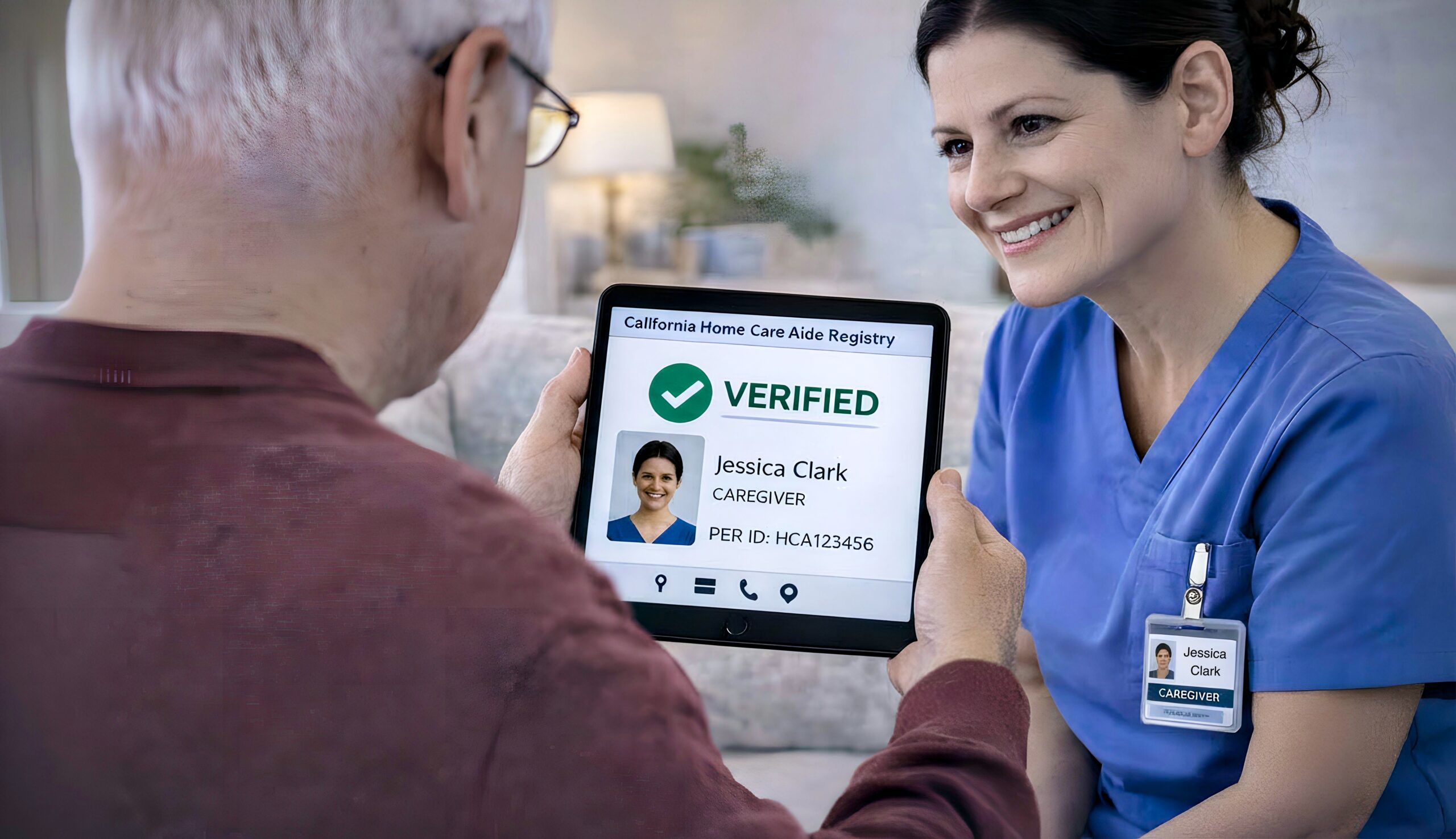
Once approved, each caregiver receives a unique Personnel Identification Number (PER ID) that families can use to verify their status on the public registry.
Training Requirements
California mandates specific training for all Home Care Aides:
Initial Training (5 hours minimum):
- 2 hours of orientation covering the caregiver’s role and employment terms
- 3 hours of safety training, including emergency procedures and infection control
Annual Training (5 hours minimum):
- Client rights and safety protocols
- How to report, prevent, and detect abuse and neglect
- Population-specific competencies based on client needs
- Core caregiving skills and best practices
What Services Fall Under These Regulations?
Home care services covered by the Consumer Protection Act include non-medical assistance with activities of daily living such as:
- Bathing and personal hygiene
- Dressing and grooming
- Meal preparation and feeding assistance
- Medication reminders
- Toileting and incontinence care
- Mobility assistance and transfers
- Light housekeeping and laundry
- Companionship and supervision
- Transportation and errands
- Exercise assistance and range of motion support
How to Verify a Caregiver or Agency
California makes it easy for families to verify credentials before hiring. The public Home Care Aide Registry allows you to search for any registered caregiver using their first name, last name, and PER ID number.
The registry displays:
- Caregiver’s name
- Registration number
- Current registration status
- Expiration date
- Home care organization affiliation (if applicable)
✓ Verify caregivers — Visit the California Home Care Aide Registry and search using the caregiver’s name and PER ID
✓ Verify agencies — Search the CDSS Home Care Services database to confirm an organization’s license is active and in good standing
Labor Protections for Caregivers in 2026
California’s regulatory framework doesn’t just protect families—it also ensures fair treatment for the dedicated professionals providing care. Understanding these protections can help you recognize a quality agency that invests in its caregivers.
Current labor requirements include:
- Minimum wage: $16.90 per hour statewide (effective January 1, 2026), with some local jurisdictions requiring higher rates
- Overtime pay: 1.5× regular pay after 9 hours per day or 40 hours per week for personal attendants under California’s Domestic Worker Bill of Rights
- Paid sick leave: Minimum 5 days per year for all employees
- Employee classification: All home care aides must be W-2 employees—not independent contractors—ensuring proper tax withholding, workers’ compensation coverage, and labor protections
When caregivers are treated fairly and compensated properly, they’re more likely to stay long-term, which means better continuity of care for your loved one.
Why Choosing a Licensed Agency Matters
With the growing demand for home care—by 2030, roughly one in four Californians will be over age 60—families have more options than ever. But not all options offer the same protection.
Some families consider hiring a private caregiver directly or using an unlicensed referral service to save money. While this might seem like a cost-effective choice, it can expose you to significant risks.
What You Risk Without a Licensed Agency
✕ No verified background checks — Private caregivers aren’t required to undergo FBI and DOJ fingerprint screening
✕ No liability protection — If a caregiver is injured in your home or causes damage, you could be personally liable
✕ No workers’ compensation — You may become the employer of record, responsible for workers’ comp insurance and claims
✕ No guaranteed training — No requirement for safety training, abuse prevention education, or ongoing competency development
✕ No state oversight — No inspections, no complaint process, no accountability
✕ Tax complications — You may be responsible for payroll taxes, employment paperwork, and IRS compliance
What a Licensed Agency Provides
✓ Verified, registered caregivers — Every caregiver has passed a comprehensive background check and is listed on the state registry
✓ Full insurance coverage — General liability, professional liability, and workers’ compensation protect you and your loved ones
✓ Trained professionals — Caregivers complete required initial and ongoing training in safety, abuse prevention, and care skills
✓ Backup coverage — If your regular caregiver is sick or unavailable, a licensed agency provides qualified replacements
✓ Care management — Professional oversight ensures care plans are followed, and quality is maintained
✓ Regulatory accountability — The state monitors licensed agencies, investigates complaints, and enforces compliance
✓ Peace of mind — You can verify your agency’s license and your caregiver’s registration at any time
The regulations exist for one reason: to protect vulnerable seniors and give families confidence in the care their loved ones receive. Choosing a licensed agency isn’t just about compliance—it’s about choosing safety, accountability, and quality.
References
- California Department of Social Services. Home Care Services Consumer Protection Act Overview. Accessed January 2026.
- California Department of Industrial Relations. Minimum Wage Information. Updated January 2026.
- National Council on Aging. Get the Facts on Elder Abuse. Accessed January 2026.
- World Health Organization. Abuse of Older People Fact Sheet. June 2022.
- California Health and Safety Code, Sections 1796.10–1796.63. Home Care Services Chapter.
- U.S. Bureau of Labor Statistics. Home Health and Personal Care Aides Occupational Outlook. 2024.
Let All Heart Home Care Help
At All Heart Home Care, we’ve been a licensed, compliant home care organization since before California’s regulations took effect—because we’ve always believed in doing things the right way. As a veteran-owned, nurse-led agency serving San Diego County since 2014, we hold ourselves to the highest standards of caregiver screening, training, and professional oversight.
Every one of our caregivers is registered with the state, background-checked, and fully trained. We carry comprehensive insurance coverage. And we believe in complete transparency—because when it comes to caring for your loved one, you deserve nothing less.
Have questions about California’s home care regulations or want to learn how All Heart can help your family? We’re here to help.
Contact All Heart Home Care at (619) 736-4677 to speak with our care team.