When it comes to nutrition for healing seniors, what your loved one eats after surgery, illness, or injury can make the difference between a full recovery and a prolonged struggle.
Your mom had surgery three weeks ago. The incision still hasn’t closed.
Your dad fell and fractured his wrist. Two months later, he’s still in pain and can barely use his hand.
Your loved one recovered from pneumonia, but they’re still exhausted, weak, and can’t seem to bounce back.
What’s going on?
The answer might be sitting right in front of them—or more accurately, not sitting in front of them.
Poor nutrition is the hidden reason seniors don’t heal. And it’s shockingly common.
Studies show that up to 50% of hospitalized seniors are malnourished—and malnutrition slows healing, increases infection risk, lengthens hospital stays, and dramatically raises the chance of readmission and death.
But here’s the encouraging news: proper nutrition can reverse this. The right foods, eaten consistently, transform the body’s ability to heal from illness, injury, and surgery.
This article explains why nutrition matters so much for healing—and precisely what seniors need to eat to recover faster and stronger.
Why Seniors Struggle to Heal
Healing isn’t automatic. It requires energy, building blocks (protein), and specific nutrients to:
- Close wounds
- Repair damaged tissue
- Fight infection
- Rebuild bone and muscle
- Restore strength and energy
When the body doesn’t get what it needs, healing simply stalls.
And as we age, getting adequate nutrition becomes surprisingly difficult due to:
→ Decreased appetite — Illness, medications, and aging itself suppress hunger
→ Increased nutritional needs — Healing demands MORE calories and protein than usual, not less
→ Medication side effects — Pain meds cause constipation and nausea; antibiotics disrupt digestion
→ Physical limitations — Pain, weakness, or mobility issues make shopping and cooking nearly impossible
→ Cognitive decline — Memory problems disrupt meal planning and preparation
→ Social isolation — Eating alone after hospitalization feels depressing and pointless
The result? Seniors eat less precisely when their bodies need more, and healing grinds to a halt.
The Devastating Consequences of Malnutrition During Recovery
When seniors don’t receive adequate nutrition during recovery from illness, injury, or surgery, the consequences are severe.
Wounds Don’t Close
Skin, tissue, and muscle need protein, vitamin C, zinc, and other nutrients to repair. Without them:
- Surgical incisions stay open longer
- Pressure ulcers (bedsores) develop or worsen
- Cuts and scrapes take weeks to heal instead of days
- Infection risk skyrockets
Bones Don’t Mend
Fractures require calcium, vitamin D, protein, and magnesium to heal. Malnourished seniors experience:
- Delayed bone healing (or bones that never fully heal)
- Increased risk of future fractures
- Chronic pain
- Permanent disability
Infections Take Hold
The immune system needs protein, vitamins A, C, D, and E, and zinc and selenium to fight infection. Without them:
- Post-surgical infections become common
- UTIs, pneumonia, and other infections develop
- Recovery time doubles or triples
- Hospitalization becomes necessary
Muscle Wasting Accelerates
After surgery, illness, or injury, the body breaks down muscle for energy if it doesn’t get enough protein and calories. This causes:
- Severe weakness
- Inability to walk or stand independently
- Increased fall risk
- Loss of independence
Hospital Readmissions Increase
Malnourished seniors are 3x more likely to be readmitted to the hospital within 30 days of discharge. Why? Because they never fully healed in the first place.
Mortality Risk Doubles
Seniors who are malnourished during recovery have twice the mortality rate of those who are well-nourished.
This isn’t an exaggeration. It’s data.
How the Body Heals—And What It Needs to Do It
Healing occurs in stages, and each stage has specific nutritional requirements.
Stage 1: Inflammation (Days 1-5)
What’s happening: The body sends white blood cells to the injury site to prevent infection and begin the cleanup process.
What it needs:
- Protein — To produce immune cells and antibodies
- Vitamin C — To support immune function
- Zinc — To reduce inflammation and support immune response
- Water — To transport nutrients and remove waste
Stage 2: Tissue Formation (Days 5-21)
What’s happening: The body builds new tissue to close wounds, repair damage, and restore function.
What it needs:
- Protein — The primary building block for new tissue (most critical nutrient)
- Vitamin C — Essential for collagen production (collagen holds tissue together)
- Vitamin A — Supports cell growth and skin integrity
- Zinc — Aids in protein synthesis and wound closure
- Iron — Carries oxygen to healing tissues
Stage 3: Remodeling (Weeks 3-24+)
What’s happening: The body strengthens and refines newly formed tissue, rebuilding strength and function.
What it needs:
- Protein — To strengthen and maintain new tissue
- Calcium and Vitamin D — To rebuild bone density
- Omega-3 fatty acids — To reduce inflammation and support recovery
- B vitamins — To support energy production and nerve healing
Bottom line: Without adequate nutrition at every stage, healing stalls or fails.
The Essential Nutrients for Healing
1. Protein (THE Most Critical Nutrient)
Why it matters: Protein is the primary building block for healing. Every cell, tissue, bone, muscle, and organ is made of protein. Without adequate protein, the body cannot:
- Close wounds
- Fight infection
- Rebuild muscle
- Heal bones
- Produce antibodies
How much do seniors need:
- Every day needs: 0.8 grams per kilogram of body weight
- During recovery: 1.2-2.0 grams per kilogram—that’s 50-100% MORE protein than usual
For a 150-pound (68 kg) senior, that means:
- Every day needs: 54 grams of protein daily
- Recovery needs: 82-136 grams daily
Best protein sources:
- Eggs (6g per egg) — easy to digest, complete protein
- Greek yogurt (15-20g per cup) — also provides calcium
- Chicken or turkey (25g per 3 oz) — lean, versatile
- Fish (20-25g per 3 oz) — also provides omega-3s
- Cottage cheese (14g per half cup) — soft, easy to eat
- Beans and lentils (15g per cup) — also high in fiber
- Protein shakes (15-30g per serving) — convenient when appetite is low
- Tofu (10g per half cup) — plant-based, soft texture
How to get more:
- Add protein to every meal and snack
- Start the day with eggs or Greek yogurt
- Add beans to soups and salads
- Drink protein shakes between meals
- Choose protein-rich snacks (cheese, nuts, hard-boiled eggs)
2. Vitamin C (The Wound-Healing Vitamin)
Why it matters: Vitamin C is essential for collagen production—the protein that holds skin, tissue, and blood vessels together. Without it, wounds don’t close.
How much do seniors need:
- Every day needs: 75-90 mg daily
- During recovery: 200-500 mg daily
Best sources:
- Bell peppers (1 cup: 190 mg)
- Oranges (1 medium: 70 mg)
- Strawberries (1 cup: 85 mg)
- Broccoli (1 cup: 80 mg)
- Kiwi (1 medium: 70 mg)
- Tomatoes (1 cup: 25 mg)
- Cantaloupe (1 cup: 65 mg)
How to get more:
- Include citrus fruit or berries at breakfast
- Snack on bell peppers with hummus
- Add tomatoes to sandwiches and salads
- Drink orange juice (choose 100% juice, no added sugar)
3. Zinc (The Immune and Wound Supporter)
Why it matters: Zinc supports immune function, reduces inflammation, and accelerates wound closure. Deficiency slows healing dramatically.
How much do seniors need:
- Every day needs: 8-11 mg daily
- During recovery: 15-25 mg daily
Best sources:
- Oysters (6 medium: 32 mg) — the highest source
- Beef (3 oz: 7 mg)
- Pumpkin seeds (1 oz: 2 mg)
- Lentils (1 cup: 2.5 mg)
- Chickpeas (1 cup: 2.5 mg)
- Cashews (1 oz: 1.6 mg)
- Eggs (1 large: 0.6 mg)
How to get more:
- Add pumpkin seeds to oatmeal or salads
- Include beans in soups and stews
- Snack on nuts
- Eat lean meat 2-3 times per week
4. Vitamin A (For Skin and Tissue Integrity)
Why it matters: Vitamin A supports cell growth, immune function, and skin integrity. It’s essential for wound healing and preventing infection.
How much do seniors need:
- Every day needs: 700-900 mcg daily
- During recovery: 1,000-1,500 mcg daily
Best sources:
- Sweet potatoes (1 medium: 1,400 mcg)
- Carrots (1 cup: 1,000 mcg)
- Spinach (1 cup cooked: 940 mcg)
- Kale (1 cup: 885 mcg)
- Cantaloupe (1 cup: 270 mcg)
- Red bell peppers (1 cup: 235 mcg)
How to get more:
- Eat orange and dark green vegetables daily
- Roast sweet potatoes as a side dish
- Add spinach or kale to smoothies, soups, or omelets
5. Calcium and Vitamin D (For Bone Healing)
Why they matter: Calcium is the primary mineral in bone. Vitamin D helps the body absorb calcium. Both are essential for healing fractures and preventing future breaks.
How much do seniors need:
Calcium:
- Every day needs: 1,200 mg daily
- During bone healing: 1,500 mg daily
Vitamin D:
- Every day needs: 600-800 IU daily
- During bone healing: 1,000-2,000 IU daily
Best calcium sources:
- Dairy (milk, yogurt, cheese)
- Fortified plant milks (almond, soy)
- Leafy greens (kale, collards, bok choy)
- Canned fish with bones (sardines, salmon)
- Tofu (calcium-set)
Best vitamin D sources:
- Fatty fish (salmon, mackerel, sardines)
- Fortified milk and plant milks
- Egg yolks
- Sunlight (15-20 minutes daily)
- Supplements (often necessary for seniors)
6. Omega-3 Fatty Acids (For Reducing Inflammation)
Why they matter: Omega-3s reduce inflammation, support immune function, and may speed recovery from surgery or illness.
Best sources:
- Fatty fish (salmon, mackerel, sardines) — 2-3 servings per week
- Walnuts (1 oz daily)
- Chia seeds (1 tablespoon daily)
- Flax seeds (1 tablespoon ground daily)
7. Iron (For Oxygen Delivery)
Why it matters: Iron carries oxygen to healing tissues. Low iron levels can cause fatigue, weakness, and slow healing.
Best sources:
- Red meat (beef, lamb) — most absorbable form
- Chicken and turkey (dark meat)
- Lentils and beans
- Spinach and Swiss chard
- Fortified cereals
✓ Pro tip — Pair iron-rich foods with vitamin C to increase absorption (e.g., spinach salad with orange slices)
8. Hydration (The Forgotten Essential)
Why it matters: Water transports nutrients to cells, removes waste, supports digestion, and maintains blood volume. Dehydration slows healing dramatically.
How much do seniors need: 6-8 cups daily—more during illness or recovery.
How to increase intake:
- Keep water within arm’s reach at all times
- Set reminders to drink
- Offer water-rich foods (soup, watermelon, cucumber, yogurt)
- Provide flavored water if plain water is unappealing
Sample Healing Meal Plan
Here’s what a healing-focused day of eating looks like:
Breakfast
- Scrambled eggs (2 eggs) with spinach and cheese
- Whole-grain toast with avocado
- Orange slices
- Milk or fortified plant milk
Why it works: High protein, vitamin C, calcium, vitamin D, healthy fats
Mid-Morning Snack
- Greek yogurt with berries and walnuts
Why it works: Protein, vitamin C, omega-3s, calcium
Lunch
- Grilled salmon with lemon
- Quinoa or brown rice
- Roasted sweet potato and broccoli
- Side salad with olive oil dressing
Why it works: High protein, omega-3s, vitamin A, vitamin C, zinc, healthy fats
Afternoon Snack
- Hummus with bell peppers and carrots
- Handful of almonds
Why it works: Protein, vitamin C, vitamin A, healthy fats
Dinner
- Chicken breast or lentil stew
- Steamed kale with garlic
- Whole-grain roll
- Fruit salad (cantaloupe, strawberries, kiwi)
Why it works: High protein, vitamin A, vitamin C, fiber, calcium
Evening Snack
- Cottage cheese with pumpkin seeds and fruit
Why it works: Protein, zinc, vitamin C, calcium
Special Considerations for Post-Surgery and Illness Recovery
After Surgery
- Increase protein by 50-100% to support wound healing
- Avoid alcohol (interferes with healing and medications)
- Limit sugar (suppresses immune function)
- Stay hydrated (IV fluids during surgery cause initial fluid loss)
After Bone Fractures
- Prioritize calcium, vitamin D, and protein
- Avoid excessive caffeine (may interfere with calcium absorption)
- Include weight-bearing activity as approved by the doctor (stimulates bone growth)
After Illness (Pneumonia, UTI, Flu)
- Focus on immune-supporting nutrients: protein, vitamin C, zinc, and vitamin D
- Eat small, frequent meals if appetite is low
- Include probiotic-rich foods (yogurt, kefir) to restore gut health after antibiotics
How In-Home Caregivers Accelerate Healing Through Nutrition
Here’s the reality: seniors who are recovering from illness, injury, or surgery rarely have the energy, appetite, or ability to shop, cook, and eat properly. And that’s precisely when nutrition matters most.
This is where professional in-home caregivers become healing partners.
How All Heart Home Care Supports Recovery
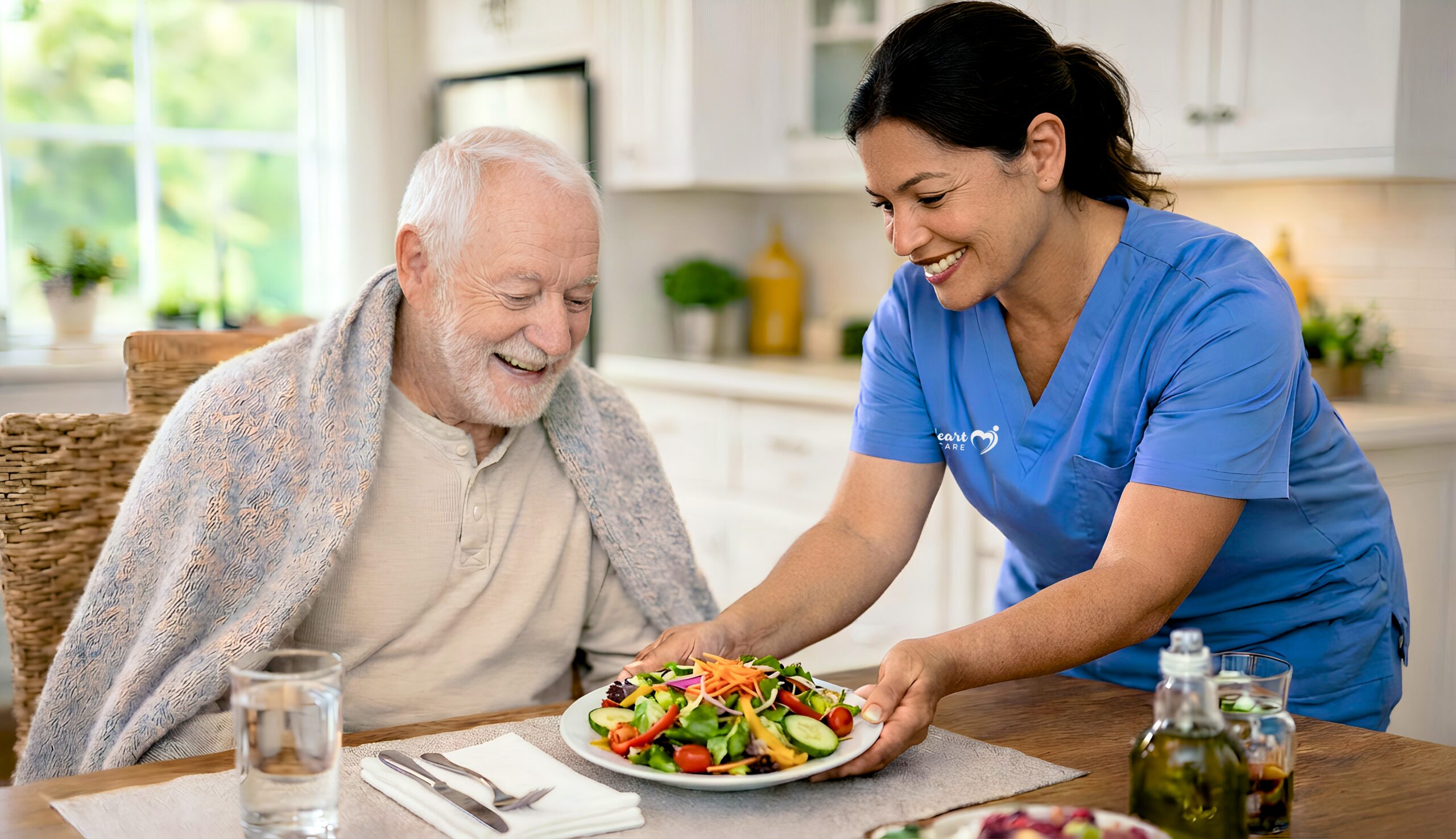
✓ Preparing healing-focused meals — Our caregivers cook nutrient-dense meals specifically designed to support recovery: high protein, rich in vitamins and minerals, easy to digest
✓ Increasing meal frequency — We provide 5-6 small meals throughout the day to meet increased calorie and protein needs without overwhelming the appetite
✓ Adapting textures for comfort — Post-surgery or during illness, chewing may be painful. We prepare soft, easy-to-eat foods: scrambled eggs, smoothies, soups, mashed potatoes, and yogurt
✓ Grocery shopping for healing ingredients — We stock kitchens with protein-rich foods, fresh fruits and vegetables, and recovery-supporting supplements
✓ Monitoring intake and hydration — We track what seniors eat and drink, ensuring they’re meeting nutritional goals and staying hydrated
✓ Providing mealtime companionship — Eating together encourages better intake and makes meals more enjoyable during a difficult time
✓ Coordinating with healthcare providers — We communicate with doctors, dietitians, and physical therapists to ensure nutrition aligns with medical treatment
✓ Managing medication schedules — We ensure medications are taken with food (when needed) and don’t interfere with appetite or digestion
The result? Faster healing, fewer complications, shorter recovery times, and better outcomes.
When to Seek Professional Nutritional Support
Contact your loved one’s doctor or request a dietitian referral if:
- Weight loss exceeds 5% of body weight in 1 month or 10% in 6 months
- Wounds aren’t healing after 2-3 weeks
- Appetite remains poor for more than a week
- Nausea, vomiting, or diarrhea persists
- Extreme fatigue or weakness doesn’t improve
- Confusion or cognitive changes develop
Registered dietitians can:
- Assess nutritional status
- Calculate precise protein and calorie needs
- Create customized meal plans
- Recommend appropriate supplements
- Monitor progress and adjust plans
Quick Recovery Nutrition Checklist
✓ Protein at every meal — eggs, chicken, fish, beans, Greek yogurt
✓ Vitamin C-rich foods daily — citrus, berries, peppers, broccoli
✓ Zinc-rich foods — nuts, seeds, beans, lean meat
✓ Calcium and vitamin D — dairy, fortified foods, leafy greens
✓ Colorful vegetables — for vitamin A and antioxidants
✓ Healthy fats — olive oil, avocado, fatty fish, nuts
✓ Hydration — 6-8 cups of water daily
✓ Small, frequent meals — 5-6 times per day
✓ Minimize sugar and processed foods
✓ Consider protein supplements — if appetite is low
The Bottom Line
You can’t heal without adequate nutrition. It’s physiologically impossible.
The body needs specific nutrients—especially protein, vitamin C, zinc, calcium, and vitamin D—to close wounds, fight infection, rebuild tissue, and restore strength.
Seniors recovering from surgery, illness, or injury need MORE nutrition than usual, not less—precisely when appetite, energy, and ability are at their lowest.
Proper nutrition can:
- Cut healing time in half
- Reduce infection risk by 50%
- Prevent hospital readmission
- Restore independence faster
- Save lives
Poor nutrition guarantees the opposite.
References
- Tseng, H.-K., et al. (2025). Malnutrition and Frailty Are Associated with a Higher Risk of Prolonged Hospitalization and Mortality in Hospitalized Older Adults. Nutrients, 17(2), 221. MDPI
- Volkert, D., et al. (2022). Malnutrition in Hospitalized Old Patients: Screening and Diagnosis, Clinical Outcomes, and Management. Nutrients, 14(4), 910. MDPI
- Cederholm, T., et al. (2023). Malnutrition in older adults. The Lancet, 401(10384), 1225-1236. ScienceDirect
- Norman, K., et al. (2021). Malnutrition in Older Adults—Recent Advances and Remaining Challenges. Nutrients, 13(8), 2764. PMC
- ESPEN Guidelines on Clinical Nutrition and Hydration in Geriatrics. European Society for Clinical Nutrition and Metabolism.
- Academy of Nutrition and Dietetics. Position of the Academy: Food and Nutrition for Older Adults.
We Can Help
At All Heart Home Care, we’ve spent 12 years helping San Diego seniors recover from surgery, illness, and injury by providing the nutrition their bodies desperately need to heal.
If your loved one is recovering and struggling to eat well, we can help.
Our caregivers prepare healing-focused meals, ensure adequate intake, and provide the support that transforms recovery from slow and painful to steady and successful.
Call us at (619) 736-4677 for a free in-home consultation.
We’ll assess your loved one’s recovery needs and develop a personalized nutrition plan to support faster, more complete healing.
Because healing isn’t just about time. It’s about giving the body what it needs to repair itself.