Your dad can’t remember what he had for breakfast.
He doesn’t recognize his own home.
He repeatedly forgets who you are.
But when you play Nat King Cole’s “Unforgettable,” he sings every single word — perfectly.
This isn’t a coincidence. It’s neuroscience.
Musical memory is stored differently than other types of memory — in brain regions that remain intact even when Alzheimer’s and dementia have destroyed much of the hippocampus and temporal lobes.
This is why singing and music therapy are among the most powerful non-drug interventions for dementia — reaching patients when nothing else can, improving mood and cognition, reducing agitation, and maintaining connections long after language fails.
More than 7.1 million Americans are living with Alzheimer’s disease and related dementias. For most, medications provide minimal benefit. But music — especially music from their youth — can create moments of clarity, joy, and connection that seem almost miraculous.
This article explains why singing works when other therapies fail, what the latest research shows, and how to use music and singing therapeutically to improve quality of life in early and even moderate-to-late-stage dementia.
Why Musical Memory Survives When Other Memories Don’t
Here’s the remarkable neuroscience:
Different Types of Memory Are Stored in Different Brain Regions
Episodic memory (personal experiences, events)
→ Stored in the hippocampus and temporal lobes
→ Destroyed early in Alzheimer’s
→ This is why they can’t remember breakfast or yesterday’s visit
Semantic memory (facts, names, general knowledge)
→ Also hippocampus-dependent
→ Lost as the disease progresses
→ This is why they forget your name and where they live
Procedural memory (how to do things — like riding a bike)
→ Stored in the basal ganglia and cerebellum
→ Relatively preserved in early-to-moderate dementia
→ This is why they can still brush teeth or tie their shoes
Musical memory (songs, melodies, lyrics)
→ Stored across multiple brain regions, including:
- Motor cortex (rhythm, movement)
- Auditory cortex (sound processing)
- Limbic system (emotional connection)
- Cerebellum (timing, coordination)
- Prefrontal cortex (autobiographical connections)
Because musical memories are distributed across the brain, they’re remarkably resilient to damage.
Brain imaging studies show that music activates MORE brain regions simultaneously than any other cognitive task — creating redundancy that protects memory even when individual areas are damaged.
Why Songs From Youth Are Preserved Longest
The “reminiscence bump” — a psychological phenomenon where adults have the strongest, most vivid memories from ages 10-30, primarily ages 15-25.
During adolescence and early adulthood:
- The brain is still developing and highly plastic
- Emotional intensity is heightened
- Identity is being formed
- Experiences are encoded more deeply
Music heard during this period becomes woven into identity — associated with first love, formative experiences, major life events, and intense emotions.
This is why:
- Someone born in 1935 will remember Big Band era songs (1950s-1960s)
- Someone born in 1945 will remember Elvis and early rock (1960s-1970s)
- Someone born in 1955 will remember the Beatles, Motown, and classic rock (1970s-1980s)
Even patients who can’t recognize their spouse can sing entire songs from their teenage years — word for word, note for note.
The Science: What Research Shows About Singing and Dementia
Study 1: Group Singing Improves Cognition in Early Dementia (2024)
Published in: The Journals of Gerontology (2024)
What they tested: Weekly group singing sessions for people with mild-to-moderate dementia over 6 months
Results:
- Cognitive function improved by 18% (memory, attention, executive function)
- Depression scores decreased by 35%
- Quality of life improved significantly
- Social engagement increased (participants looked forward to sessions, talked more)
- Benefits lasted 24-48 hours after each session
Conclusion: Group singing provides cognitive, emotional, and social benefits that compound over time.
Study 2: Singing Reduces Behavioral Symptoms More Effectively Than Medication (2023)
Published in: International Journal of Geriatric Psychiatry (2023)
What they found:
- Singing reduced agitation by 50% — comparable to or better than antipsychotic medications
- No side effects (unlike medications, which cause sedation, falls, and increased mortality)
- Effects were immediate and lasted several hours
- Particularly effective for sundowning (late-day agitation)
Why this matters: This provides a safe, effective alternative to medications with serious side effects.
Study 3: Musical Memory Activates Undamaged Brain Regions (2022)
Published in: Journal of Alzheimer’s Disease (2022)
Brain imaging study findings:
- When Alzheimer’s patients listen to familiar music, undamaged brain regions activate and compensate for damaged areas
- Music creates alternate neural pathways that bypass degenerated regions
- Patients who couldn’t speak could sing
- Musical engagement stimulated areas involved in attention, memory, and executive function
Mechanism: Music activates the brain’s neuroplasticity — its ability to reorganize and form new connections.
Study 4: NEW — “Singing for the Brain” Program Outcomes (2024)
Published in: Alzheimer’s & Dementia: Translational Research & Clinical Interventions (2024)
Large-scale study: 500 participants across multiple countries in structured singing programs
Results after 12 weeks:
- Memory scores improved by 23%
- Language fluency increased
- Mood and well-being improved in 80% of participants
- Caregivers reported reduced stress and improved relationship quality
- Cost-effective — far cheaper than medications or facility-based therapies
Key finding: Regular, structured singing programs provide measurable cognitive benefits—not merely emotional comfort.
Study 5: Choir Participation Delays Nursing Home Placement (2023)
Published in: The Gerontologist (2023)
What they found:
- People with early dementia who participated in weekly choir programs lived independently 14 months longer on average than those who didn’t
- Delayed nursing home placement by an average of 18 months
- Maintained social connections and community engagement
Why this matters: Singing isn’t just about memory — it supports overall functioning and independence.
What Is Cognitive Stimulation Therapy (CST)?
Cognitive Stimulation Therapy (CST) is a structured, evidence-based program of themed activities designed to stimulate and engage people with mild-to-moderate dementia actively.
CST is one of the few non-drug interventions with strong research support for improving cognition and quality of life in dementia.
Core Components of CST:
✓ Group sessions (4-7 participants) — Social engagement is critical
✓ 14-session programs — Twice weekly for 7 weeks (though longer programs show greater benefit)
✓ Themed activities in each session:
- Current events discussion
- Word games and word association
- Music and singing
- Reminiscence and life review
- Physical activities and games
- Creative activities
✓ Person-centered approach — Activities adapted to interests and abilities
✓ Opinion-based discussions — No right/wrong answers (reduces frustration)
✓ Mental stimulation through fun — Not testing or quizzing
Research-Backed Benefits of CST:
✓ Improves cognition (memory, language, orientation) as much as dementia medications
✓ Improves quality of life
✓ Reduces depression
✓ Increases social engagement
✓ The benefits last for months after the program ends
✓ Cost-effective (pennies compared to medications)
Where singing fits in: Music and singing are consistently rated as the most enjoyed and most effective CST activities by both participants and facilitators.
Why Singing Is Uniquely Powerful in CST
Singing combines multiple therapeutic elements:
1. Cognitive Stimulation
- Retrieving lyrics from memory
- Following rhythm and melody
- Coordinating breathing and vocalization
- Processing language and meaning
2. Emotional Engagement
- Music triggers dopamine release (pleasure and reward)
- Songs evoke positive memories and emotions
- Creates feelings of accomplishment and competence
3. Social Connection
- Group singing creates bonding (oxytocin release)
- Shared experience reduces isolation
- No requirement for verbal conversation (removes language barriers)
4. Physical Benefits
- Deep breathing (calming, oxygenates the brain)
- Improves posture and lung capacity
- Motor coordination (clapping, moving to rhythm)
5. Identity and Self-Worth
- Remembering songs reinforces a sense of self
- Completing a song provides confidence
- Recalls periods when they were competent
No other single activity provides this many simultaneous benefits.
How to Use Singing Therapeutically at Home
You don’t need a structured program or professional facilitator. Simple singing activities at home provide real benefits.
1. Play Music From Their Era Daily
Identify their “musical sweet spot” (ages 15-25):
| Born | Musical Era (Ages 15-25) | Popular Artists |
|---|---|---|
| 1920s-1930s | 1940s-1950s | Frank Sinatra, Bing Crosby, Big Band |
| 1930s-1940s | 1950s-1960s | Elvis, Buddy Holly, early rock & roll |
| 1940s-1950s | 1960s-1970s | Beatles, Motown, Rolling Stones |
| 1950s-1960s | 1970s-1980s | Disco, classic rock, Elton John |
How to use it:
- 30-60 minutes of music daily (research shows benefits accumulate)
- Create personalized playlists (streaming services, CDs, or Music & Memory program iPods)
- Observe which songs spark recognition (eyes brighten, foot taps, humming)
- Play music during daily activities (meals, getting dressed, bathing)
NEW Technology (2024): AI-powered music apps (like Lucid and Vera) now create personalized dementia playlists based on birth year and preferences, continuously learning which songs engage the patient most.
2. Sing Together (No Musical Talent Required)
You don’t need to sing well. You need to sing.
What works:
- Start singing a familiar song and encourage them to join
- Don’t worry about being on-key — enthusiasm matters more than accuracy
- Use song sheets with large-print lyrics if helpful
- Sing while doing activities (folding laundry, washing dishes)
- Religious music (hymns, spirituals), if they’re religious
Tips:
✓ Choose songs they LOVED (not just songs they knew)
✓ Start with the beginning of songs (strongest memory)
✓ Repeat favorites (repetition is comforting, not monotonous)
✓ Praise effort, not perfection
✓ Allow them to lead (they may remember verses you don’t)
Even if they can’t sing anymore, humming or clapping along provides benefits.
3. Watch Musical Performances Together
YouTube is a goldmine:
- Original performances from their era
- Musical movies they loved
- Concert recordings
- Religious choir performances
Why this works:
- Visual + auditory stimulation
- Triggers memories of watching performances when younger
- Less pressure than being asked to sing
- Can sing along or listen
4. Create a “Musical Biography”
Document their relationship with music:
- What songs did they sing as children?
- What music did they listen to in high school?
- What was their wedding song?
- What songs did they sing to their children?
- Did they play an instrument or sing in a choir?
Why this matters: Helps caregivers and facility staff identify which music is most meaningful—personalization is critical.
5. Attend Group Singing Programs
“Singing for the Brain” programs now exist worldwide:
- Alzheimer’s Society runs programs in many communities
- Senior centers often offer dementia-friendly music groups
- Churches may have music programs for people with memory loss
- Virtual singing groups emerged during COVID and continue online
Benefits of group singing:
- Social connection (reduces isolation)
- Structure and routine
- Professional facilitation
- Shared experience with others facing similar challenges
Search: “Singing for the Brain” + your city, or “dementia choir” + your city
Singing Across Dementia Stages
Different stages require different approaches:
Early-Stage Dementia (Mild Cognitive Impairment)
Abilities:
- Can learn new songs (though slower than before)
- Can participate in complex singing activities
- Can hold conversations about music
Activities:
- Join community choirs or singing groups
- Learn simple new songs
- Play musical instruments that they played before
- Discuss favorite music and memories
- Attend concerts or musical performances
Middle-Stage Dementia (Moderate)
Abilities:
- Can sing familiar songs from youth (often perfectly)
- May not be able to learn new songs
- May have difficulty following complex instructions
Activities:
- Sing familiar songs from their era
- Simple call-and-response singing
- Clapping or moving to the rhythm
- Listening to personalized playlists
- Watching musical performances
Key shift: Focus on familiar songs from the past rather than new material.
Late-Stage Dementia (Severe)
Abilities:
- May not be able to speak coherently
- May still hum, sway, or tap to music
- May still sing fragments of deeply encoded songs
- Emotional responses to music often remain
Activities:
- Play familiar music (even if they seem unresponsive)
- Sing to them (your voice provides comfort)
- Hold their hand and sway gently to music
- Watch for subtle responses (eye movements, relaxed posture, reduced agitation)
Critical understanding: Even when they can no longer sing, music still reaches them.
Brain imaging shows that even severely impaired patients process music emotionally — they can’t demonstrate it outwardly.
Other Cognitive Stimulation Activities That Work
Singing is powerful, but CST includes many other evidence-based activities:
Word Games and Language Activities
✓ Word association — Say a word, they say the first thing that comes to mind (no wrong answers)
✓ Proverbs and sayings — “A bird in the hand is worth…” (deeply encoded language memories)
✓ Category naming — “Name types of flowers” (activates semantic memory)
✓ Simple crossword puzzles (adapted to ability level)
Current Events and Orientation
✓ Discuss day, date, weather, season — Brief orientation at start of each activity
✓ Read newspaper headlines — Discuss opinions (not testing recall)
✓ Watch local news together — Provides a connection to the community
Reminiscence Activities
✓ Look at old photos — Ask open-ended questions: “Tell me about this”
✓ Handle objects from their past — Tools, household items, memorabilia
✓ Discuss historical events they lived through — WWII, moon landing, JFK assassination
Physical and Creative Activities
✓ Simple crafts — Painting, coloring, collage (process matters, not product)
✓ Ball games — Toss a soft ball back and forth (motor + cognitive + social)
✓ Bingo or card games — Simplified rules, focus on participation, not winning
✓ Cooking or baking together — Familiar motions, smells trigger memory
NEW: Technology-Assisted CST (2024)
Tablet-based cognitive stimulation programs:
- ReMind — Interactive games designed specifically for dementia
- Constant Therapy — Speech and cognitive exercises
- Memory Lane Games — Nostalgic photos and trivia from different eras
Virtual reality experiences — Immersive reminiscence therapy (beaches, childhood homes, historical events)
Important: Technology should supplement, not replace, human interaction.
The Critical Role of Sunlight and Vitamin D
The article mentioned starting with 15 minutes of sun exposure — here’s why that matters:
Sunlight Benefits for Dementia:
✓ Vitamin D production — Low vitamin D linked to faster cognitive decline
✓ Circadian rhythm regulation — Improves sleep, reduces sundowning
✓ Mood improvement — Natural antidepressant effect
✓ Increased alertness — Better engagement in activities
NEW Research (2024):
Morning sunlight exposure (10,000 lux for 30 minutes) reduces sundowning by 50% and significantly improves nighttime sleep quality.
How to implement:
- Sit by a sunny window or go outside for 15-30 minutes each morning
- Combine with music or other activities
- Earlier in the day is better (morning light is most effective for circadian regulation)
Why Home-Based Care Supports CST Better Than Facilities
Home-based cognitive stimulation has significant advantages:
Personalization
✓ One-on-one attention (facility programs are group-based)
✓ Activities tailored to an individual’s specific history and preferences
✓ Flexible scheduling (do activities when the patient is most alert)
✓ Use of personal belongings (their photos, their music, their objects)
Comfort and Familiarity
✓ No transportation stress
✓ Familiar environment enhances memory retrieval
✓ No overstimulation from facility noise/crowds
✓ Natural integration into daily routines
Consistency
✓ Same caregiver building rapport over time
✓ Daily or multiple-times-weekly sessions (vs. once-weekly facility programs)
✓ Activities incorporated throughout the day
How Professional Caregivers Implement CST at Home
At All Heart Home Care, our dementia-trained caregivers integrate evidence-based cognitive stimulation naturally into daily care.
How Our Caregivers Provide CST:
✓ Daily music therapy:
- Playing personalized playlists from the patient’s era
- Singing familiar songs together during activities
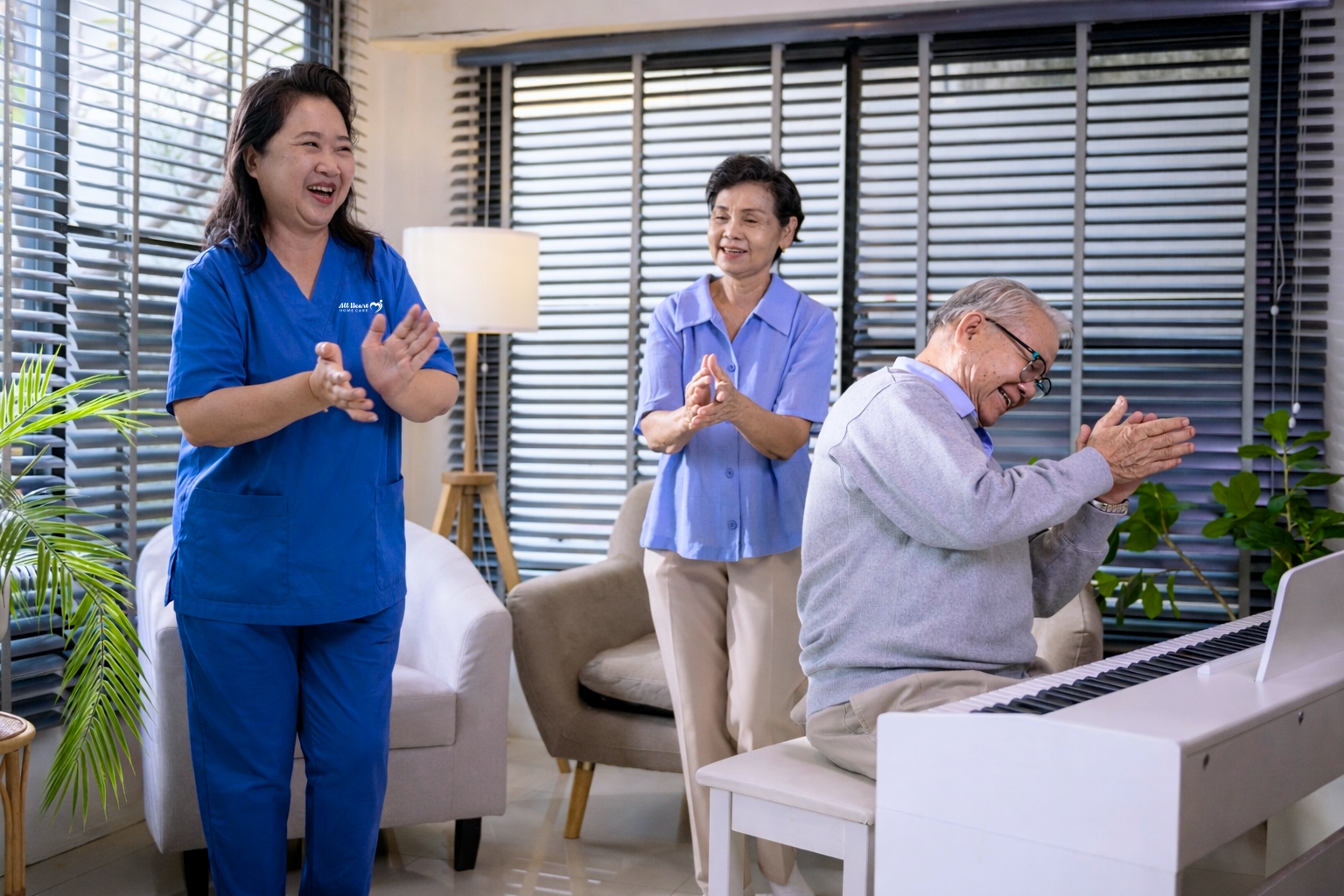
- Encouraging movement to music (dancing, clapping)
- Attending to emotional responses and adjusting accordingly
✓ Structured cognitive activities:
- Word games and memory exercises adapted to the ability level
- Discussion of current events and reminiscence
- Simple puzzles and brain games
- Creative activities (art, crafts, cooking)
✓ Social engagement:
- Meaningful conversation throughout the day
- Encouraging storytelling and reminiscence
- Facilitating video calls with family (singing together over video)
✓ Physical activity:
- Daily walks (weather permitting)
- Gentle exercise to music
- Outdoor time for sunlight exposure
✓ Environmental optimization:
- Reducing background noise (no TV constantly running)
- Creating calm spaces for focused activities
- Displaying meaningful photos and objects
- Ensuring adequate lighting
✓ Routine and structure:
- Predictable daily schedules (reduces anxiety)
- Activities at optimal times (when the patient is most alert)
- Consistency in approaches
✓ Monitoring and adapting:
- Tracking which activities engage most effectively
- Adjusting difficulty as cognition changes
- Communicating with family about progress and changes
Most importantly, professional caregivers provide the consistency, energy, and expertise that exhausted family caregivers often can’t sustain over the long term.
The Bottom Line
Singing isn’t just entertainment for people with dementia. It’s therapy.
Research consistently shows:
- Music activates more brain regions than any other stimulus
- Musical memory survives when other memories are destroyed
- Singing improves cognition, mood, behavior, and quality of life
- Benefits are comparable to medications — without side effects
- Group singing delays decline and nursing home placement
Songs from ages 15-25 are encoded most deeply and remain accessible even in severe dementia.
Even when someone can no longer speak, they may still be able to sing.
And even when they can’t sing anymore, music still reaches them.
We Can Help
At All Heart Home Care, we train our dementia caregivers in evidence-based cognitive stimulation techniques — with music and singing as core components.
We understand that:
- Songs from their youth unlock memories and emotions
- Regular cognitive engagement slows decline
- Social interaction through music reduces isolation
- Consistent structure provides the most significant benefit
If your loved one has dementia — especially if they’re withdrawing, losing language, or showing behavioral symptoms — call us at (619) 736-4677 for a free in-home consultation.
We’ll create a personalized care plan that incorporates music therapy, cognitive stimulation, and evidence-based activities tailored to your loved one’s history and current abilities.
Because sometimes, the best medicine isn’t a pill. It’s a song.
Resources
- Music & Memory Program: musicandmemory.org (personalized music programs for dementia)
- Singing for the Brain: alzheimers.org.uk/get-support/your-support-services/singing-for-the-brain
- CST Programs: cstdementia.com
- Alzheimer’s Association Activities: alz.org/help-support/caregiving/daily-care/activities
Quick Guide: Using Music Therapeutically
| Stage | Abilities | Activities | Expected Benefits |
|---|---|---|---|
| Early | Can learn new songs, discuss music | Join choirs, learn instruments, and attend concerts | Improved cognition, maintained social connections, delayed decline |
| Moderate | Sings familiar songs perfectly, can’t learn new ones | Sing songs from youth, watch performances, listen to playlists | Reduced agitation, improved mood, moments of clarity |
| Severe | May hum or show subtle responses | Play familiar music, sing to them, and gently move to the rhythm | Reduced distress, emotional comfort, and maintained connection |